How Do You Know if You Are About to Astral Project

Astral projection (also known as astral travel), is a term used in esotericism to describe an intentional out-of-body experience (OBE)[1] [ii] that assumes the existence of a subtle trunk called an "astral trunk" through which consciousness tin can function separately from the physical trunk and travel throughout the astral plane.[3] [4] [five]
The thought of astral travel is ancient and occurs in multiple cultures. The modernistic terminology of "astral projection" was coined and promoted by 19th-century Theosophists.[3] It is sometimes reported in association with dreams and forms of meditation.[6] Some individuals accept reported perceptions similar to descriptions of astral projection that were induced through various hallucinogenic and hypnotic means (including cocky-hypnosis). There is no scientific evidence that there is a consciousness whose embodied functions are divide from normal neural activeness or that one can consciously leave the body and make observations of the physical universe,[7] and astral projection has been characterized as a pseudoscience.[eight] [9] [10] [xi] [12] [13] [14] [ excessive citations ]
Accounts [edit]
Aboriginal Egypt [edit]

Like concepts of soul travel appear in diverse other religious traditions. For example, ancient Egyptian teachings nowadays the soul (ba) equally having the power to hover outside the physical body via the ka, or subtle body.[15]
Judaic and Christian Origins [edit]
Carrington, Muldoon, Peterson, and Williams claim that the subtle body is attached to the physical torso past means of a psychic silver string.[16] [17] The final chapter of the Book of Ecclesiastes is often cited in this respect: "Before the silver cord exist loosed, or the golden bowl be broken, or the bullpen be shattered at the fountain, or the wheel be broken at the cistern."[xviii] Scherman, however, contends that the context points to this being merely a metaphor, comparing the torso to a machine, with the silver cord referring to the spine.[19]
Paul's Second Epistle to the Corinthians is more generally agreed to refer to the astral planes:[twenty] "I know a human being in Christ who fourteen years ago was caught upwardly to the 3rd sky. Whether it was in the body or out of the body I practice not know—God knows."[21] This statement gave rise to the Visio Pauli, a tract that offers a vision of heaven and hell, a forerunner of visions attributed to Adomnan and Tnugdalus every bit well as of Dante's Divine One-act.
Western esotericism [edit]
According to the classical, medieval, renaissance Hermeticism, Neoplatonism, and later Theosophist and Rosicrucian thought, the 'astral body' is an intermediate body of light linking the rational soul to the concrete body while the astral plane is an intermediate globe of lite betwixt Heaven and Globe, equanimous of the spheres of the planets and stars. These astral spheres were held to be populated past angels, demons, and spirits.[22] [23]
In the Neoplatonism of Plotinus, for example, the private is a microcosm ("small world") of the universe (the macrocosm or "great world"). "The rational soul...is alike to the great Soul of the Earth" while "the fabric universe, similar the body, is made as a faded image of the Intelligible". Each succeeding aeroplane of manifestation is causal to the next, a world-view known as emanationism; "from the Ane gain Intellect, from Intellect Soul, and from Soul - in its lower stage, or that of Nature - the cloth universe".[24] The idea of the astral figured prominently in the work of the nineteenth-century French occultist Eliphas Levi, whence it was adopted and adult further past Theosophy, and used afterwards by other esoteric movements.
The subtle bodies, and their associated planes of being, grade an essential part of some esoteric systems that deal with astral phenomena. Often these bodies and their planes of existence are depicted as a series of concentric circles or nested spheres, with a separate body traversing each realm.[25]
Hinduism [edit]
Similar ideas such every bit the Liṅga Śarīra are plant in ancient Hindu scriptures such every bit, the YogaVashishta-Maharamayana of Valmiki.[15] Modernistic Indians who take vouched for astral projection include Paramahansa Yogananda who witnessed Swami Pranabananda doing a phenomenon through a possible astral projection.[26]
The Indian spiritual teacher Meher Baba described one's use of astral project:
In the advancing stages leading to the kickoff of the path, the aspirant becomes spiritually prepared for being entrusted with costless use of the forces of the inner world of the astral bodies. He may then undertake astral journeys in his astral trunk, leaving the concrete body in sleep or wakefulness. The astral journeys that are taken unconsciously are much less important than those undertaken with full consciousness and equally a result of deliberate volition. This implies witting employ of the astral body. Witting separation of the astral body from the outer vehicle of the gross body has its ain value in making the soul feel its distinction from the gross trunk and in arriving at fuller control of the gross body. Ane can, at will, put on and have off the external gross body every bit if it were a cloak, and apply the astral body for experiencing the inner world of the astral and for undertaking journeys through it, if and when necessary....The power to undertake astral journeys therefore involves considerable expansion of i's scope for experience. Information technology brings opportunities for promoting ane'southward own spiritual advancement, which begins with the involution of consciousness.[27]
Astral project is one of the Siddhis considered achievable by yoga practitioners through self-disciplined practice. In the epic The Mahabharata, Drona leaves his physical body to see if his son is live.
Taoist [edit]
Taoist alchemical practice involves creation of an energy trunk by breathing meditations, drawing free energy into a 'pearl' that is then "circulated".[28] "Xiangzi ... with a drum as his pillow fell fast asleep, snoring and motionless. His primordial spirit, notwithstanding, went straight into the banquet room and said, "My lords, here I am once more." When Tuizhi walked with the officials to take a look, there really was a Taoist sleeping on the ground and snoring like thunder. Yet inside, in the side room, there was another Taoist chirapsia a fisher drum and singing Taoist songs. The officials all said, "Although in that location are 2 different people, their faces and clothes are exactly akin. Clearly he is a divine immortal who can divide his body and appear in several places at in one case. ..." At that moment, the Taoist in the side room came walking out, and the Taoist sleeping on the basis woke upwards. The ii merged into ane."[29]
Japanese mythology [edit]

In Japanese mythology, an ikiryō ( 生霊 , also read as shōryō, seirei, or ikisudama) is a manifestation of the soul of a living person separately from their trunk.[30] Traditionally, if someone holds a sufficient grudge confronting some other person, it is believed that a office or the whole of their soul can temporarily leave their torso and appear before the target of their hate in order to expletive or otherwise impairment them, like to an evil eye. Souls are also believed to get out a living body when the torso is extremely sick or comatose; such ikiryō are not malevolent.[31] [32]
Indigenous traditions [edit]
Amazon [edit]
The yaskomo of the Waiwai is believed to be able to perform a "soul flying" that tin serve several functions such equally healing, flying to the sky to consult cosmological beings (the moon or the blood brother of the moon) to get a proper noun for a new-born baby, flying to the cave of peccaries' mountains to ask the father of peccaries for affluence of game or flying deep down in a river to get the help of other beings.[33]
Inuit [edit]
In some Inuit groups, people with special capabilities, known as angakkuq, are said to travel to (mythological) remote places, and report their experiences and things important to their fellows or the entire community; how to stop bad luck in hunting, cure a sick person etc.,[34] [35] things unavailable to people with normal capabilities.[36]
Terminology [edit]
The expression "astral projection" came to be used in 2 different ways. For the Gilded Dawn[37] and some Theosophists[38] it retained the classical and medieval philosophers' pregnant of journeying to other worlds, heavens, hells, the astrological spheres and other imaginal[39] landscapes, but outside these circles the term was increasingly applied to not-physical travel around the concrete globe.[40]
Though this usage continues to be widespread, the term, "etheric travel", used by some afterward Theosophists, offers a useful distinction. Some experients say they visit different times and/or places:[41] "etheric", then, is used to represent the sense of being "out of the trunk" in the physical world, whereas "astral" may connote some amending in time-perception. Robert Monroe describes the former type of projection as "Locale I" or the "Hither-Now", involving people and places that really exist:[42] Robert Bruce calls it the "Real Time Zone" (RTZ) and describes it equally the non-physical dimension-level closest to the physical.[43] This etheric body is unremarkably, though not always, invisible just is often perceived by the experient as connected to the physical body during separation by a "silver cord". Some link "falling" dreams with projection.[44]
Co-ordinate to Max Heindel, the etheric "double" serves as a medium between the astral and concrete realms. In his organisation the ether, also chosen prana, is the "vital strength" that empowers the physical forms to change. From his descriptions it can be inferred that, to him, when one views the physical during an out-of-body experience, one is non technically "in" the astral realm at all.[45]
Other experiments may describe a domain that has no parallel to any known concrete setting. Environments may be populated or unpopulated, bogus, natural or abstruse, and the experience may be beatific, horrific or neutral. A common Theosophical conventionalities is that one may admission a compendium of mystical knowledge chosen the Akashic records. In many accounts the experiencer correlates the astral world with the world of dreams. Some even report seeing other dreamers enacting dream scenarios unaware of their wider environment.[46]
The astral environment may also be divided into levels or sub-planes by theorists, merely there are many different views in various traditions concerning the overall structure of the astral planes: they may include heavens and hells and other after-death spheres, transcendent environments, or other less-hands characterized states.[42] [44] [46]
Notable practitioners [edit]
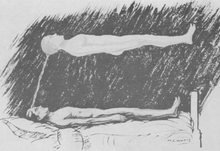
Emanuel Swedenborg was one of the first practitioners to write extensively about the out-of-body feel, in his Spiritual Diary (1747–65). French philosopher and novelist Honoré de Balzac's fictional work "Louis Lambert" suggests he may have had some astral or out-of-body experiences.[47]
There are many twentieth-century publications on astral projection,[48] although only a few authors remain widely cited. These include Robert Monroe,[49] Oliver Pull a fast one on,[50] Sylvan Muldoon, and Hereward Carrington,[51] and Yram.[52]
Robert Monroe'southward accounts of journeys to other realms (1971–1994) popularized the term "OBE" and were translated into a large number of languages. Though his books themselves simply placed secondary importance on descriptions of method, Monroe also founded an institute defended to inquiry, exploration and not-profit dissemination of auditory technology for assisting others in achieving project and related contradistinct states of consciousness.
Robert Bruce,[53] William Buhlman,[54] Marilynn Hughes,[55] and Albert Taylor[56] have discussed their theories and findings on the syndicated show Coast to Coast AM several times. Michael Crichton gives lengthy and detailed explanations and feel of astral project in his non-fiction volume Travels.
In her volume, My Religion, Helen Keller tells of her beliefs in Swedenborgianism and how she one time "traveled" to Athens:
I have been far away all this time, and I haven't left the room...It was clear to me that information technology was because I was a spirit that I had so vividly 'seen' and felt a place a thousand miles away. Space was null to spirit![57]
The soul's power to leave the trunk at volition or while sleeping and visit the various planes of heaven is too known as "soul travel". The practise is taught in Surat Shabd Yoga, where the experience is accomplished mostly past meditation techniques and mantra repetition. All Sant Mat Gurus widely spoke nearly this kind of out of body feel, such every bit Kirpal Singh.[58]
Eckankar describes Soul Travel broadly as move of the true, spiritual self (Soul) closer to the centre of God. While the contemplative may perceive the experience every bit travel, Soul itself is said not to motion but to "come into an agreement with fixed states and conditions that already exist in some world of fourth dimension and space".[59] American Harold Klemp, the current Spiritual Leader of Eckankar[60] practices and teaches Soul Travel, as did his predecessors,[61] through wistful techniques known every bit the Spiritual Exercises of ECK (Divine Spirit).[62] Edgar Cayce from the US, was popularly known equally the "Sleeping Prophet". He had been practicing astral travel at Washington DC for many years.
In occult traditions, practices range from inducing trance states to the mental construction of a 2nd torso, called the Trunk of Calorie-free in Aleister Crowley's writings, through visualization and controlled breathing, followed by the transfer of consciousness to the secondary body by a mental deed of will.[63]
Scientific reception [edit]
At that place is no known scientific evidence that astral projection as an objective phenomenon exists.[seven] [8] [nine]
There are cases of patients having experiences suggestive of astral projection from brain stimulation treatments and hallucinogenic drugs, such as ketamine, phencyclidine, and DMT.[nine]
Robert Todd Carroll writes that the chief evidence to support claims of astral travel is anecdotal and comes "in the form of testimonials of those who claim to have experienced being out of their bodies when they may have been out of their minds."[64] Subjects in parapsychological experiments have attempted to project their astral bodies to afar rooms and see what was happening. However, such experiments haven't produced clear results.[65]
According to Bob Bruce of the Queensland Skeptics Association, astral projection is "just imagining", or "a dream land". Bruce writes that the existence of an astral plane is contrary to the limits of science. "Nosotros know how many possibilities there are for dimensions and we know what the dimensions do. None of it correlates with things like astral projection." Bruce attributes astral experiences such every bit "meetings" alleged by practitioners to confirmation bias and coincidences.[66]
Psychologist Donovan Rawcliffe has written that astral projection tin can exist explained by delusion, hallucination and vivid dreams.[67]
Arthur W. Wiggins, writing in Quantum Leaps in the Wrong Management: Where Real Science Ends...and Pseudoscience Begins, said that purported prove of the power to astral travel great distances and give descriptions of places visited is predominantly anecdotal. In 1978, Ingo Swann provided a test of his alleged ability to astral travel to Jupiter and discover details of the planet. Actual findings and information were later on compared to Swann'southward claimed observations; according to an evaluation by James Randi, Swann's accurateness was "unconvincing and unimpressive" with an overall score of 37 percent. Wiggins considers astral travel an illusion, and looks to neuroanatomy, human being belief, imagination and prior knowledge to provide prosaic explanations for those claiming to experience information technology.[11]
In popular civilization [edit]
- Band-a-Ding Daughter—fictional handling of astral projection in popular media The Twilight Zone, in which a fading extra (Maggie McNamara) is able to project her consciousness from her trunk by means of magic and rescue the inhabitants of her hometown from an impending natural disaster.
- In Dungeons and Dragons, astral projection is a powerful spell that allows travelers to transport a mental image of themselves into a strange realm known every bit the astral plane which is dictated entirely by thought and perception. It is filled with horrifying monsters and is virtually space.
- Insidious, a motion-picture show almost a male child named Dalton whose astral body gets caught in a demonic world known as The Further. His male parent, from whom he caused these abilities, must discover him and bring him back to the living world.
- The Iii Investigators #23 in the children'southward mystery series, "The Mystery of the Invisible Dog", features a graphic symbol that performs astral projection.
- Aahat (Episode 164) - A popular TV horror testify in India had an episode near astral project
- The Powers of Matthew Star - In the latter half of this 1982–1983 series, the main character Matthew Star, an conflicting prince hiding out on Earth, is shown to have the power to perform astral projections and uses it pretty regularly to help in the government assignments he and his mentor take on.
- The Sheep Talisman from the animated television series Jackie Chan Adventures grants its user the ability of astral projection.
- In the idiot box series Charmed, the character of Prue, a witch played by Shannen Doherty, has the power of astral projection and has used it many times in the series dealings with the supernatural.
- In an episode of So Weird, Fi comes across a daughter who uses astral project.
- In the HBO Idiot box series Carnivàle, central character Ben Hawkins, gains the power of astral projection and uses it to runway the movements of his estranged begetter and their kidnapper in the episode "Outskirts, Damascus, NE".
- In Fable of Korra a grapheme named Jinora is able to utilize astral projection.
- In the Take a chance Time episode "Astral Plane", A comet causes Finn the Man to Project Astrally. With no control over how to use it, he follows up on the various exploits of several characters before floating up to Mars.
- In the Gothic soap opera Dark Shadows, the characters of Barnabas Collins and Julia Hoffman take used the mystic powers of the IChing wands to project their astral body into the past while their bodies remain in a trance in the present.
- In the Curiosity Cinematic Universe live-activeness moving-picture show Dr. Strange, Stephen Strange and his instructor the Aboriginal I utilize astral travel.
- In Netflix'south Chilling Adventures of Sabrina, several of the characters employ astral project multiple times throughout the series.[68]
- In the CW'south The Magicians, one of the main characters, Penny Adiyodi, has the ability to do astral projections.
- In Fringe, Olivia Dunham takes a fictitious drug called Cortexiphan which allows her to experience an astral projection in a forest.
- In the 2018 Indian horror movie, Taxiwaala, ane of the characters (Sisira) experiments with astral projection to know the cause of her mother's death.
- Fuko Ibuki from visual novel Clannad is an astral projection of herself whilst she is in a coma.
- Sal Governale aka "Sal the Stockbroker" aka "Sal the Turtle" astral projected at domicile and spoke about his experience on the Howard Stern Show.
- In the Netflix original serial Stranger Things, a child victim of the MKULTRA experiments demonstrates the ability to locate and spy on others using astral projection.[69]
- In the Netflix original series Behind Her Optics, several of the main characters apply the power of astral projection, and information technology plays a major office in the plot.
- In the Marvel Cinematic Universe alive-activity serial WandaVision, Wanda Maximoff is seen using astral projection while reading the Darkhold in her remote mountain home.
- In the Astral Projection (manga) the master character is listening to a jazz recording to become out of his body.
- In the 1973 novel Gravity'due south Rainbow, Tyrone Slothrop's uncle Lyle Bland becomes an advanced practitioner of astral projection and uses information technology to get out the material realm. [seventy]
- In Berserk (manga) the witches Schierke and Farnese perform certain types of Witchcraft past using Astral Projection and travelling into the Astral Earth.
- In the Cartoon Network serial Steven Universe, the titular grapheme Steven discovers that he has Astral Projection powers.
Encounter too [edit]
- Astral airplane
- Bilocation
- Esotericism
- Dream earth (plot device)
- Hallucination
- Hypnagogia
- Illusion
- Lucid dream
- Mental plane
- Mental projection
- Merkaba
- Metaphysics
- Simulated reality
- Simulated reality in fiction
- Sleep paralysis
- Soul retrieval
- Surat Shabd Yoga
- Tattva vision
- Teleportation
- Thoughtform
- Yoga-nidra
References [edit]
- ^ Varvoglis, Mario, Out-Of-Body Experiences (OBE or OOBE) , retrieved 9 July 2016
- ^ Myers, Frederic W.H. (2014), "Astral Projection", Journal for Spiritual & Consciousness Studies, 37 (1): 52
- ^ a b Crow, John 50 (2012), "Taming the astral body: the Theosophical Society's ongoing problem of emotion and command", Journal of the American Academy of Faith, 80 (three): 691–717, doi:10.1093/jaarel/lfs042
- ^ "Webster'south New Millennium Dictionary of English, Preview Edition (v 0.ix.7)", Dictionary.com, n.d., archived from the original on 31 July 2016, retrieved 9 July 2016
- ^ "Astral projection", The Skepdic's Dictionary, 27 Oct 2015
- ^ Zusne, Leonard; Jones, Warren H. (1989), Anomalistic Psychology: A Written report of Magical Thinking' , Psychology Press, ISBN978-0-8058-0508-6
- ^ a b Brian Majestic. (2009). Pseudoscience: A Critical Encyclopedia. Greenwood. p. 29. ISBN 978-0-313-35507-3 "Other than anecdotal eyewitness accounts, there is no known evidence of the ability to astral projection, the being of other planes, or of the Akashic Record."
- ^ a b Terence Hines. (2003). Pseudoscience and the Paranormal. Prometheus Books. pp. 103-106. ISBN 978-1573929790
- ^ a b c Robert L. Park. (2008). Superstition: Belief in the Age of Sciences. Princeton University Press. pp. xc-91. ISBN 1-4008-2877-5.
- ^ Martin Gardner (17 Oct 2001). Did Adam and Eve Accept Navels?: Debunking Pseudoscience. West. West. Norton. pp. 158–. ISBN978-0-393-32238-v.
- ^ a b Charles M. Wynn; Arthur W. Wiggins; Sidney Harris (2001). Breakthrough leaps in the wrong direction: where existent science ends-- and pseudoscience begins. Joseph Henry Printing. pp. 95–. ISBN978-0-309-07309-7 . Retrieved 24 December 2011.
- ^ Patrick Grim (1982). Philosophy of Science and the Occult. SUNY Printing. pp. 92–. ISBN978-i-4384-0498-1.
- ^ Calhoun, Ada (12 March 2015). "Why I Stopped Believing in Pseudoscience". Cosmopolitan.
- ^ Massimo Pigliucci; Maarten Boudry; Daniel Thurs; Ronald Numbers (16 August 2013). Philosophy of Pseudoscience: Reconsidering the Demarcation Problem. Academy of Chicago Press. pp. 138–. ISBN978-0-226-05182-6.
- ^ a b Melton, J. G. (1996). Out-of-the-torso Travel. In Encyclopedia of Occultism & Parapsychology. Thomson Gale. ISBN978-0-8103-9487-2.
- ^ Projection of the Astral Body by Carrington and Muldoon
- ^ Out of Body Experiences: How to have them and what to expect by Robert Peterson (chapters 5, 17, 22)
- ^ Ecclesiastes 12:half-dozen
- ^ Rabbi Nosson Scherman, ed. (2011). The ArtScroll English Tanach. ArtScroll Serial (First ed.). Brooklyn, New York: Mesorah Publications, Ltd. p. 1150. ISBN978-1-4226-1065-vii.
- ^ Hankins, James (2007). "Ficino, Avicenna and the Occult Powers of the Rational Soul". Atti di Convegni (Istituto Nazionale di Studi Sul Rinascimento).
- ^ 2 Corinthians 12:ii
- ^ Dodds, E.R. Proclus: The Elements of Theology. A revised text with translation, introduction, and commentary, 2nd edition 1963, Appendix.
- ^ Pagel, Walter (1967). William Harvey's Biological Ideas. Karger Publishers. pp. 147–148. ISBN978-3-8055-0962-vi.
- ^ John Gregory, The Neoplatonists, Kyle Cathie 1991 pp15–sixteen
- ^ Besant, Annie Woods (1897). The Ancient Wisdom: An Outline of Theosophical Teachings. Theosophical publishing society. ISBN978-0-524-02712-seven.
- ^ Wikisource:Autobiography of a Yogi/Chapter 3
- ^ Baba: 90, 91.
- ^ Chia, Mantak (2007) [1989]. Fusion of the 5 Elements. Destiny Books. pp. 89+. ISBN978-1-59477-103-three.
- ^ Erzeng, Yang (2007). The Story of Han Xiangzi. Academy of Washington Press. pp. 207–209. ISBN978-0-295-98690-6.
- ^ Clarke, Peter Bernard (2000). Japanese new religions: in global perspective, Volume 1999 (annotated ed.). Routledge. p. 247. ISBN978-0-7007-1185-vii.
- ^ Ramesh Chopra Academic Lexicon Of Mythology 2005, p. 144
- ^ Patrick Drazen A Gathering of Spirits: Japan's Ghost Story Tradition: from Folklore and Kabuki to Anime and Manga 2011, p. 131
- ^ Fock 1963: 16
- ^ Kleivan & Sonne 1985: seven–8, 12, 23–24,26, 27–29, 30, 31
- ^ Merkur 1985: four–6
- ^ Hoppál 1975: 228
- ^ Chichi Cicero, Chichi C, Sandra Tabatha Cicero The Essential Gilded Dawn, Llewellyn Worldwide, 2003.
- ^ Arthur A.Powell, THE ASTRAL Body AND OTHER ASTRAL PHENOMENA, The Theosophical Publishing House, London, England; Wheaton, Ill, U.s.A.; Adyar, Chennai, India, 1927, reprinted in 1954 and 1965, page 7, online June 2008 at http://hpb.narod.ru/AstralBodyByPowell-A.htm
- ^ Henri Corbin, Creative Imagination in the Sufism of Ibn Arabi, tr. Ralph Mannheim, Bollingen XCI, Princeton U.P., 1969
- ^ eastward.g. William Judge, The Ocean of Theosophy 2nd Ed. TPH, 1893, Chapter 5, book online June 2008 at http://www.theosociety.org/pasadena/body of water/oce-hp.htm
- ^ Astral-Projections.com"Secret Guide To Instant Astral Projection Archived 22 November 2009 at the Wayback Machine"
- ^ a b Journeys Out of the Trunk by Robert A. Monroe, p 60. Anchor Press, 1977.
- ^ Astral Dynamics past Robert Bruce Hampton Roads Publishing Company, Inc, 1999. p 25-27, 30-31
- ^ a b Astral Dynamics by Robert Bruce. Hampton Roads Publishing Company, Inc, 1999 ISBN 1-57174-143-7
- ^ Heindel, Max, The Rosicrucian Mysteries (Chapter Four, The Constitution of Man: Vital Body - Desire Body - Mind), 1911, ISBN 0-911274-86-3
- ^ a b Monroe, Robert. Far Journeys. ISBN 0-385-23182-2
- ^ Frederick Lawton Balzac The Echo Library, 2007, p. 18
- ^ "GENERAL". obebibliography.info.
- ^ "A biography of Robert Monroe by Susan Blackmore". Archived from the original on 22 Jan 2009. Retrieved 9 March 2009.
- ^ "A biography of Oliver Play a trick on past Susan Blackmore". Archived from the original on 26 Feb 2009. Retrieved ix March 2009.
- ^ Blackmore, Susan. "A biography of Sylvan Muldoon". Archived from the original on 22 Jan 2009.
- ^ "A biography of Yram by Susan Blackmore". Archived from the original on 22 January 2009. Retrieved 9 March 2009.
- ^ "Robert Bruce - Biography & Interviews". Coast to Coast AM.
- ^ "William Buhlman - Biography & Interviews". Declension to Coast AM.
- ^ "Marilynn Hughes - Biography & Interviews". Coast to Coast AM.
- ^ "Albert Taylor - Biography & Interviews". Coast to Coast AM.
- ^ Keller, Helen (1927). My Organized religion (Showtime ed.). Garden Urban center: Doubleday, Folio & Company. p. 33. Retrieved 12 Dec 2017.
- ^ See chapter 5 of the book Crown of Life by Kirpal Singh available online at [ane]
- ^ "Soul Travel". www.eckankar.org.
- ^ "Sri Harold Klemp, Spiritual Leader of Eckankar". world wide web.eckankar.org.
- ^ "ECKANKAR: ECK Masters". www.eckankar.org.
- ^ "ECKANKAR: The Spiritual Exercises of ECK". www.eckankar.org.
- ^ Greer, John (1967). Astral Project. In The New Encyclopedia of the Occult. Llewellyn Worldwide. ISBN978-i-56718-336-viii.
- ^ Robert Todd Carroll (31 July 2003). The skeptic's lexicon: a collection of foreign beliefs, amusing deceptions, and dangerous delusions. John Wiley and Sons. pp. 33–. ISBN978-0-471-27242-seven . Retrieved 24 December 2011.
- ^ Blackmore, Susan (1991). "Near-Death Experiences: In or out of the trunk?". Skeptical Inquirer 1991, 16, 34-45. Commission for Skeptical Inquiry. Retrieved 17 June 2008.
- ^ Frazer, Peter (30 September 2010). "Astral projection? In your dreams, say sceptics". Brisbane Times . Retrieved 24 December 2011.
- ^ Rawcliffe, Donovan. (1988). Occult and Supernatural phenomena. Dover Publications. p. 123
- ^ Oswald, Anjelica (17 December 2018). "Things yous may accept missed on Netflix's 'Chilling Adventures of Sabrina'". Business Insider . Retrieved 20 September 2020.
- ^ Alexander, Leigh (18 September 2016). "I Tried Astral Projection in a Flotation Tank and All I Got Was a Text Message". Vice . Retrieved 20 September 2020.
- ^ Pynchon, Thomas (1973). Gravity'due south Rainbow. 2006. p590. Penguin Classics
- Baba, Meher (1967). Discourses. Vol. II. San Francisco: Sufism Reoriented. ISBN 1-880619-09-i.
- Fock, Niels (1963). Waiwai. Organized religion and society of an Amazonian tribe. Nationalmuseets skrifter, Etnografisk Række (Ethnographical series), Eight. Copenhagen: The National Museum of Kingdom of denmark.
- Hoppál, Mihály (1975). "Az uráli népek hiedelemvilága és a samanizmus". In Hajdú, Péter (ed.). Uráli népek. Nyelvrokonaink kultúrája és hagyományai (in Hungarian). Budapest: Corvina Kiadó. pp. 211–233. ISBN978-963-13-0900-3. The title means: "Uralic peoples / Culture and traditions of our linguistic relatives"; the affiliate ways "The belief organisation of Uralic peoples and the shamanism".
- Hoppál, Mihály (2005). Sámánok Eurázsiában (in Hungarian). Budapest: Akadémiai Kiadó. ISBN978-963-05-8295-vii. The title ways "Shamans in Eurasia", the book is written in Hungarian, merely information technology is published too in German, Estonian and Finnish. Site of publisher with brusk description on the book (in Hungarian)
- Kleivan, Inge; B. Sonne (1985). Eskimos: Greenland and Canada. Iconography of religions, section VIII, "Arctic Peoples", fascicle 2. Leiden, The netherlands: Plant of Religious Iconography • Country University Groningen. E.J. Brill. ISBN978-xc-04-07160-5.
- Merkur, Daniel (1985). Becoming One-half Hidden: Shamanism and Initiation among the Inuit. Acta Universitatis Stockholmiensis • Stockholm Studies in Comparative Religion. Stockholm: Almqvist & Wiksell. ISBN978-91-22-00752-4.
- Klemp, Harold (2003). Past Lives, Dreams, and Soul Travel. Eckankar. Minneapolis, MN. [Eckankar Spider web site: http://www.eckankar.org]: Eckankar. ISBN978-1-57043-182-1.
- Roi, Alex. Astral Project and Lucid Dreams, [Web site=http://www.howtoluciddreamsfast.org].
Farther reading [edit]
- Robert Bruce (1999). Astral Dynamics: A New Arroyo to Out-of-Body Experiences. Hampton Roads Publishing. ISBN i-57174-143-vii.
- Robert Todd Carroll (2003). The Skeptic's Dictionary: A Collection of Strange Beliefs, Agreeable Deceptions, and Dangerous Delusions. John Wiley & Sons. ISBN 0-471-27242-6.
- Thomas Gilovich (1993). How We Know What Isn't And then: The Fallibility of Human Reason in Everyday Life. Costless Press. ISBN 0-02-911706-two.
- Terence Hines (2003). Pseudoscience and the Paranormal. Prometheus Books. ISBN 1-57392-979-4.
- Robert Monroe (1971). Journeys Out of the Trunk Doubleday. Reprinted (1989) Souvenir Press Ltd. ISBN 0-385-00861-9.
- Sylvan Muldoon and Hereward Carrington (1929). Project of the Astral Body. Rider and Company. ISBN 0-7661-4604-9.
External links [edit]
- Astral Projection at the Skeptic's Dictionary
Source: https://en.wikipedia.org/wiki/Astral_projection

Post a Comment for "How Do You Know if You Are About to Astral Project"